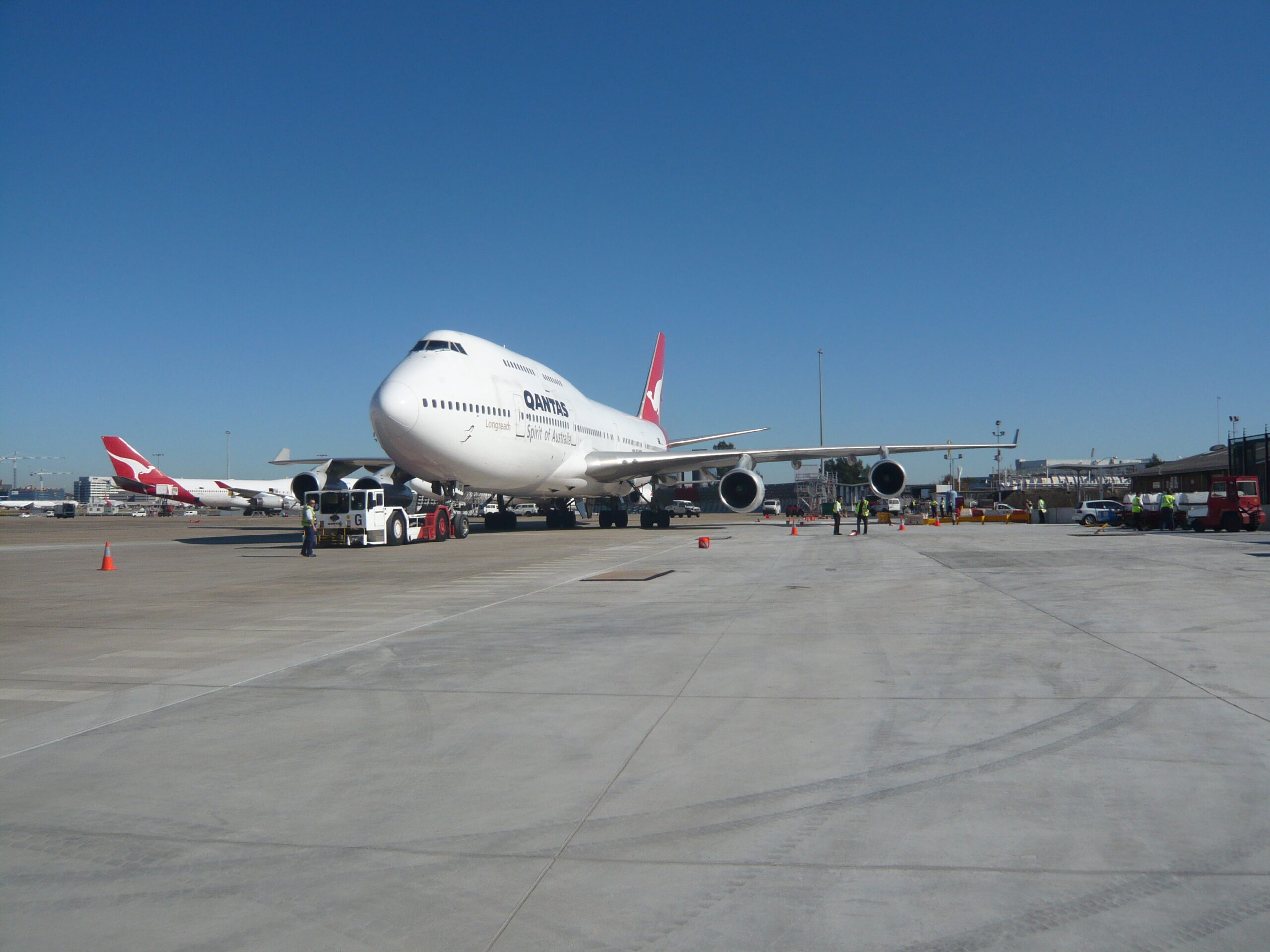
Changes to the Qantas feel of aircraft resulted in the need for a new Code E maintenance bay at the Qantas Mascot jet base to service B747 and A330 aircraft displaced by the new A380 fleet.
Woolacotts was engaged by RPS Group Sydney on behalf of Qantas Airways Limited. We were involved from the start of this project and was responsible for determining how to fit the bay into the confined space available within the Jet Base.
The project involved the extension of the existing hardstand pavement at the northeast sector of the jet base to accommodate a new maintenance bay, requiring the reconfiguration of an internal access road to accommodate aircraft tug movements, the relocation of security gates, huts and airside fencing and the modification of existing landside car parking areas.
The maintenance bay features 3,000 m² of new hardstand, huts for maintenance personnel, 400 Hz ground power for aircraft and new apron lighting. The hardstand area incorporates a water collection system, to allow aircraft to be washed down on the hardstand. As contaminated wash down water cannot be drained to stormwater, a diversion system was included, which diverts all wash down water and the initial storm runoff to a storage tank for treatment. This allows the remaining water to drain to the stormwater system, via treatment devices.
The road realignment works also include the removal and replacement of old underground fuel storage tanks. Access and timing for catering trucks is critical to the ongoing operations of the airline, and it was imperative that the existing roadway remained functional throughout the project.
In addition to the civil works, we also designed the structural elements of the project. This included a large high awning over the security gate, to provide protection for the security personnel, and underground tanks for storage of wash down water
Safety in design was an important factor for the project and process involved an initial review to analyze stakeholder inputs and the operational brief and investigation of several options to optimize the project outcomes. Throughout the project, at critical stages, further sessions were held to ensure no other potential risks been created.
The design of the agreed solution was developed to allow the capital expenditure budget to be determined. Approval of the proposed solution, and capital expenditure budget was obtained from the Qantas board, prior to completion of the project design and documentation, and construction of the project.
The project was finished in mid 2012 on time and as budgeted. Stormwater testing post construction also confirmed that the project meets all environmental requirements.